Friday, September 15, 2017

Learning in Trust and Trust in Learning

It's a real struggle for many teachers to let go of content and control. It can be hard to let go to trust your students to know that they have the best intentions at heart.  But the more you can do this, the deeper the students will delve into their learning.  

Read and imagine this exchange between Eve, Poppy, Pam, and Lizzie (pseudonyms), a smart group of fourth grade girls of mixed ethnicity in a Title One school in Colorado.

The scene- the students are in Inquiry Circles discussing the book they are reading, The Watsons Go to Birmingham:1963 (Curtis). In this part of the conversation they are examining characters in the text while learning about the civil rights era in the United States.

Here, they wonder about Bryon the older brother in the story. The girls discuss whether or not he can be trusted, or is telling the truth.  In the beginning of the conversation the teacher (Ramona) is not at the group. She enters about half way through and contributes to the conversation. She is monitoring more than one Inquiry Circle and dips in and out of the meetings occurring around the classroom. Eve's job in the Inquiry Circle is to encourage making connections to the text, and so she begins:


Eve:        Does anyone have a connection to that?  Byron trouble.  Does one of you?  (Pointing her pencil at each of the three other girls.)
Poppy:   Yes.
Pam:       Can you tell your connection?  Lizzie, you go first.
Lizzie:    How like my brother every time- 'cause when we got our bunk beds, I got to sleep on the top. And he was like, “On the bottom is better!”  And it’s not!  Because it’s all like you could hear the person move on the top, and he was just fooling around with me just to try to go up there.
Poppy:   My connection is from my big brother, Ben.  He’s thirteen.  And when I try to call my mom’s he acts like he’s not there. And then she actually calls out his name. He’s like really there and so she’s like Ben go away!
Ramona: And so you gotta judge him out a little bit.
Poppy:   And so he usually does that every day that I usually see him. And so now I don’t even believe him when he’s trying to tell the truth because-
Ramona: So you don’t trust him.
Poppy:   Yea.  It’s kind of like  “The Boy Who Cried Wolf.”
Ramona:  So, do you think Byron’s gonna be like that?  I assume you’re talking about Byron even though I wasn’t here.
Poppy:   Yea.
Eve:        (Raises her hand to speak) Well, one time I was about six years old and my brother- I used to sleep with my brother, because I was afraid of the dark. And one time he told me to go get him a glass of milk with the light on.  He turned the light off and he’s like there’s a monster coming for you that just ran under the bed. So now I don’t trust him anymore.
Ramona: Sometimes, it’s hard to trust your big brothers and sisters.
Poppy:    'Cause they always try to fool you around and try to make you believe. 


First of all, what's notable in this scenario is that these 4th grade girls know how to "do" an Inquiry Circle on their own. They draw each other in for comment, do not hog the conversational floor, and they build on each others ideas. It's a real conversation. They are able to dig into this character collectively and by the end they show they really "get" Byron and his motivations.


Secondly what is notable is how the teacher assumes the best in her students. Rather than assume they are off task with their discussion of the connections to their families, she assumes that they ARE talking about the text. She knows that it was Bryon, in the book, that they must be referring to in their connections, even if Byron's name is not yet mentioned. The teacher's preparation for today's Inquiry Circles is evident in her knowledge of the book, its characters, and what the students read for this meeting. This preparation allowed her to drop into the conversation and guide them fluidly.  But, that preparation at home the night before was not enough.  Here, her preparedness is clearly paired with her trust in the girls ability to have an academic conversation about the text on their own. She prepared them for this and now she can trust that the conversations are good in that space. And she is right! That is the art of teaching.

This three minute interchange is a powerful example of the art of teaching.  Ramona accomplished so much in this short interchange.  She gently brings them back to the text with positive intention, and got an affirming response from Pam. She affirmed, to the girls, that they were on the right track by engaging in real conversation with them. She validated their third space interactions (it's hard to trust your big brothers and sisters).  And, she checked and confirmed that the goal of the conversation was directly related back to the book. All of this was done in a way that kept the conversation going, and built rapport with her students through the learning.

This example gives us a look into the classroom of an expert teacher, who has mastered that art. She trusts that they want to learn. She affirms their contributions, and validates their connections to the work.  It sounds simpler than it is.  But it is definitely something to strive for as we develop our own art.

If I were to assess this collaboration on a Common Core Rubric, these girls would be all scored as advanced.  And the teacher... well, she's pretty amazing!


Wednesday, September 13, 2017

Inquiry is IMMERSIVE learning

So, yesterday I was working on writing the Elementary book in the Guided Inquiry Design series.  I was working with some lessons on wave energy for fourth grade. (Sent to me from a rock star librarian, through my work with the wonderful educators of Norman, Oklahoma) Throughout the day, I was immersing myself in what the learners would do in this unit, in what order these activities fell, and how the order and content would impact their understanding and in turn their ability to craft excellent inquiry questions on the concept to pursue further. (Instructional DESIGN) Working in this way, viewing the videos, examining the experiments, and thinking of the timing of it all, IMMERSED me in the concept of waves and the specific content of light, water, and sound waves, much like it would do for our students. I was thinking really hard about why kids might even want to care about this. I believe that it's important for the learning to be relevant (third space).

After a long day of work, my daughter got home from school and we decided to take a break and go paddle boarding on the local lake.  We had been kayaking recently and decided to try out paddle boarding for the first time. Since they rent them at our local recreation center run lake, we thought we would take them out to enjoy the indian summer weather while it lasted.  It was hard to balance and stand the first time, I was a bit wobbly and unsure. But as my comfort increased, I began to enjoy the beauty of my surroundings.

While I am working on balancing my body on top of this board, immersed in the experience, the beautiful breathtaking views of the sun setting over the Rockies to my west, I had an epiphany.

I had been immersed in the concept of waves all day, playing with the ideas and experiments, watching the videos and in this moment on my paddle board,  EVERYTHING around me connected to that unit of study.

Motorboats were speeding by with wake boarders creating waves. The waves were upsetting my balance and caused me to steady my board. The ducks were making ripples in the water that eventually lapped the shore.  If you are in water, there are waves.  Waves have power, you feel their power when you are on a paddle board and your balance is at stake!

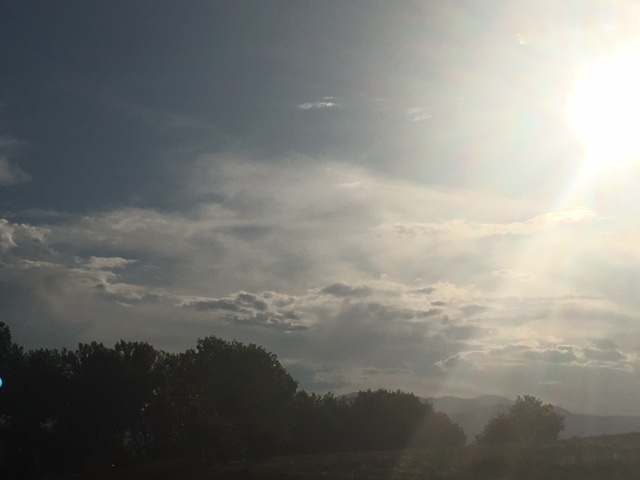
Then I looked to my west at the setting sun.  The light rays were filtering through various holes on the clouds affecting where the light fell and how the sun's energy was directed.  Light rays were being presented to me.

And then there were these loons, who would disappear in the water to pop up again in another place. They were calling their mates with an odd crying sound.  Sound waves were traveling to my ears.

Through opening to the moment, I realized that inquiry based learning, when done well, and when learners are open to the learning through an inquiry stance, provides an immersive experience into life.  Mindfulness, if you will.  If you allow it, as you learn, you will see your world with new eyes. Excellently designed inquiry based learning can provide our students with a unique and new lens with which to see the world.

If we can recognize this immersion through inquiry, we should ask our students about the connections they are making in the world.  Help them to be open to what the world offers them by asking, "What connections did you make to waves last night?  Did you interact with any waves, when, how.... "

Through inquiry based learning in school, all of our lives are enriched!  We can show our students to use the immersive experience of GID to OPEN their eyes to experience the world with new information and understanding. That is what learning, true learning, is all about. Isn't it?

Tuesday, November 10, 2015

The Wonder Wheel

Guided Inquiry and the Wonder Wheel

I love that people are so creative and like to synthesize their thoughts into maps that support the work they do.

Here is a research model from West Cary that supports teachers and librarians in research.  It's pretty comprehensive. I call it the WonderWheel.  It includes details about how to learn through research and some great ideas at a conceptual level of inquiry.

West Cary Instructional Resources (Where I found the model)
Resources for the model

My life has a sound track- many times when I have an idea it connects to a song (see my last post for another musical link).  The cool thing about a blog is that you can bring all those pieces together in one place.  And so for your musical enjoyment, I give you Dan Zanes WonderWheel. It's the soundtrack for this blogpost. I enjoy all kinds of music and have really enjoyed Dan Zanes with my daughter. You should check them out!

Back to this model... It has everything- evaluation in the center, student indicators, teaching tools for each part and big ideas that shape each stage in this Wonder Wheel!  So Kudos to the West Cary Middle School in Cary, NC.

As an author of Guided Inquiry and Guided Inquiry Design, I see clear alignment with this wheel and our phases of Guided Inquiry Open, Immerse, Explore and Identify in the Wonder section, Gather, Create in Investigate; Create in Synthesize and Create, Share, and Evaluate in Express.  It's interesting how much attention is spent in the Create phase through this model. Create is explored in depth recognizing what it takes to shift to new understandings. In Guided Inquiry we think of Create more as creating new understandings than creating a product. This model reflects that kind of thinking as well and values the work it takes to do so.

Guided Inquiry emphasizes the Open, Immerse and Explore phases mainly because so many educators rush these phases as they don't recognize the amazing pay off when focused time is spent in the beginning that later enables creation and learning. The traditional research assignment completely ignores these early and essential phases.  I think some of these items in create happen earlier as well, such as rich academic vocabulary development.  The Wonder Wheel asks to "tap prior knowledge" but doesn't make the commitment to build background information together as we suggest in Guided Inquiry.  This important step helps students to generate informed questions for deeper learning through the rest of the process.

In our new edition of Guided Inquiry: Learning in the 21st Century , we describe how the writing process connects to the inquiry process. The complexity of create in this model can be explained by that complex nature of construction of new understandings that occurs in that Create phase of Guided Inquiry.

It's interesting to see how different people visualize the inquiry process and how it weaves in so many different kinds of learning.  Always a fun mind puzzle for me to make connections to our work and implementation factors of Guided Inquiry Design.


Wednesday, February 11, 2015

From Strong Roots and Connections to Others We Grow

Digging into the roots 
I've been down and out the last two weeks with an injured knee and now a virus, but a little beam of light came to me through an email.  A library student at central North Carolina University emailed me because she was doing a biography on me for a class.  What a delight and surprise.

The assignment was an interesting one and came out of her library class reading our first book, Guided Inquiry: Learning in the 21st Century (2007). The names are all researchers that we included in the text.

ASSIGNMENT # 3 – Guided Inquiry Theorists and Researchers
Choose one of these personalities and provide the background and principles that these individuals used to impact 21st century schools.  
Your textbook will provide preliminary information but additional resources should be used to discuss their contributions to Guided Inquiry.  
Personalities:  John Dewey, Keith Curry Lance, Jerome Bruner, Louise Limberg, Vygotsky, Piaget, J. Donham, K. Bishop, Carol Kuhlthau, Diane Oberg, D. Elkind, Violet Harada, J. Yoshina,  L. Maniotes
  
No more than two students may report on the same personality.  Sign up on a first-come, first-serve basis HERE on Discussion Board.  Presentation should be submitted to the thread where you listed the person you selected.   Submit a PowerPoint presentation with 10 – 15 slides on your chosen personality ...

So she emailed me directly when she found little biographical information on me on the internet.  She thought she was imposing on me with her questions, but I was happy to respond. However, it wasn't until she asked me some real specifics that I got digging a little deeper myself into my own history to my roots.  She asked,
In working on my project about Guided Inquiry and your role in it, I find I have a questions that I have not been able to answer. If you have a moment I would love to pick your brain.

  1. What event or influence from your early career pushed you in the direction of guided inquiry learning?
  2. Were there any students, fellow teachers or administrators who pushed you in the GI direction?
  3. Did you face any resistance?


These questions gave me pause.  And I began to reach back farther than my Third Space research into my own teaching and learning about how to teach.  I enjoyed the journey, and so I thought it might be worth sharing here. Here was my answer to her questions.

Well, I went to Guilford College as an undergraduate student of education.  Our program there really highlighted the teaching of the whole child.  We were taught to teach through an inquiry lens in a way having students ask questions about objects, as they investigate.  As I went into a classroom of my own, I found these short inquiries engaging to students, but it wasn’t quite enough.  I knew with more attention and time inquiry like that could get students to deeper learning.

I grew up with some understanding of my mother’s theory as she was doing her doctoral research while I was in and completing high school.  So I began to wonder about how elementary students could take on more of that kind of research and how it might look if it started with inquiry like the ones I had in my classroom.  I always felt that teachers had an opportunity to take students to deeper learning than was often happening and I felt there was a system or structure that was needed to help teachers to engage in that way.  So I began early connecting research and inquiry learning together and thinking about how these two pieces could be implemented at all ages.

When I was at Guilford College (1988 -89) my professor took our class on an observation visit to Duke School for Children.  It was the university school that has since closed down. But that experience was one that shaped me.  It seemed to be the very vision of what we were talking about in classes. Holistic environment where students were learning, collaborating on things very interesting to them, in fun and playful ways.  It was theme based, but beyond that there was high engagement.  The students used a store to practice math concepts, there were projects everywhere and lots of things happening.  The school was a buzz with learning like no other school I had seen before.  

Unfortunately, that school was not the norm, as I came to find out.  So the resistance is quite literally everywhere. That was why we felt it so important to write the books.  We wanted people to have a clear vision for a different way of learning in schools.  We wanted them to see why this is important to all students right now.  That was what we wrote in the first book, Guided Inquiry Learning in the 21st Century.  We wanted not only librarians but all educators to know about the ISP and the power of a practice that is aligned with what research says about how students learn, not how we teach.  So this is a student driven learning process.  But the exciting thing for me was to pair it with the term Guided.  Through my first years of teaching I realized that I didn’t know exactly how to teach students to read.  So I began my quest into understanding that, which led me to New Zealand where the literacy rate was 99% and digging deeper into Guided Reading and Reading Recovery.  Marie Clay was a researcher that like my mother, looked at how students engaged in a process (reading) and used that evidence to develop a program that matched how students learn to read.  First understand the students, then determine how we teach them!

So from my learning about reading instruction, I decided that my mom’s process was really important work to share, that it could help people to GUIDE students through research and much of the learning in schools could take on this form.  But things would have to shift for that to happen.  

So many things needed shifting- Here are just a few...
  • Recognizing that research based practice is more important than a text book program.
  • Seeing libraries as a central part of the learning in schools was one big shift.  And that is a shift in teachers, administrators as well as the librarians themselves. 
  • Shifting to flexible schedules where the total school program incorporated libraries and research in more central ways.  
These shifts are challenges, but with the new technology it is so much more possible now. Librarians can cull resources on the web for specific inquiries and curate their own resources for teachers using bookmarking and other tools.  There is just a tremendous potential for this approach now, more than ever before, and so I see the obstacles becoming smaller and smaller.

But the mental shift it requires is not small.  And, it is probably our biggest hurdle.  

Do people believe that school can and should be more?  What is our vision for schools and our students?  What our our essential questions that drive the learning in schools?  Why are we doing what we are doing, and how can it be better?

Those are the things we need to ask ourselves today to recognize where we are in history, in the time of information, and shift our approaches to meet the needs of the next generation.  

I am ever hopeful that Guided Inquiry and GIDesign are tools, the structure and way to design learning experiences that are aligned to how students learn through the ISP and support a collaborative culture in schools that libraries have been seeking for years. I hope  that people see through GID these are possible, reachable and that they provide a road map for giving students a deeper learning experience in school.  For they all deserve it.


After sending it and she was pleased with my response, I realize how wonderful it is that we can reach out to others and connect today to learn, and grow from one another.  I had a chance to reflect on my roots with this practice and she got some information and inspiration for implementing Guided Inquiry in her school.  Isn't that lovely?

Tuesday, November 11, 2014

Our Experiences Shape Who We Are


Aboard about above across after against along among around at before
Behind below beneath beside between beyond by down during except for


Ok folks, rewind the tape.  I’m taking it back to 1978-1979, I was in 7th grade.  That awkward time of life when my arms and legs were long and lanky, I had metal wrapped around my every tooth with rubber bands pulling my teeth back toward my spine.  I stood 5’6” and my boyfriend Lenny stood 4’6”.  I was very unsure of myself, my stature, my place in the world.  But when asked about my favorite subject in school, I was able to squeak out the word “science.”  Why was science my favorite?  I'll come back to that later.

My second favorite was probably wood and metal shop.  My daughter uses the wooden stool I made back in 1979 everyday to reach the sink to wash her hands.  This is an actual picture of the stool I made in woodshop in 7th grade.
To adults, I’d never admit that the required “vocational educational” courses were some of my favorite learning experiences.  My third favorite was probably home economics, where we made things like English muffin pizzas and sewed a square pillow (I still have that one, too.)   In foreign language I was exposed to French, Italian, German and Spanish. Then, came our required health classes in sexual education and drug education. Back in 1979 the scare tactic was just beginning to take off and it was serious.  We watched the movie “Dead is Dead” the saddest documentary about heroine and drug abuse which completely ruined the song “Lean On Me” by Bill Withers forever.  In sex ed we learned about every venereal disease, birth control as well as how some of our more daring classmates had gotten involved in their own “investigations”.   
 
Back to academics, I loved my history teacher, but the middle ages? Serfdom was still so far removed from my life although I adored my teacher Mrs. Mensch who was also my homeroom teacher. English was the worst of them all where we had to memorize prepositions (aboard about above across after against along among around at before behind below beneath beside between beyond by down during except for…) I remember how the words were arranged on the page, and each week we were responsible for a new column of words offering us an easy A on a quiz for those who studied.   But this is something that remains with me, it’s etched in my mind.  I can recall the list anytime, anywhere.  Like it or not, this learning has stayed with me.   

As an educator I have often thought of this and wondered, Hmmm, why did we need to know this? The only fact I know about prepositions is that you shouldn’t end a sentence with one.  But, I don’t think I learned that in that same English class.  Memorizing prepositions was my way to make good grades. Memorize. I won’t even go into the details about Mrs. Barker who was missing some of her front teeth, had the look of a bulldog as well as a streak of white in her hair that resembled a skunk, talk about a character! In English our work included meaningless stuff so often that when we were asked to create projects that might have had some meaning, like write about what will you be when you grow up? I just looked at the teacher like what are you talking about?  And did it with the same frame of mind as memorizing prepositions, do it to get a grade.  A pharmacists?  REALLY, me?  I didn’t even know what that meant.  So, I mindlessly slapped together an essay.

We never read in English. Although I remember a student teacher reading aloud to us ONCE, some bizarre science fiction text… We got interrupted so many times that it seems she repeated the same part over and over.  I remember the words she read as she sat on the teacher’s desk as Mrs. Barker was out of the room, “Did the scientists really know?  Would it happen today? Would the sun come out today? Would it?”   It was some story, maybe even by Isaac Asimov or maybe Ray Bradbury about how the sun had been under a cloud for a long time and the people couldn’t wait until it came out… What a missed opportunity.   But then she left, and we never got to hear the end of the story.  Though curious, I was never encouraged to find the book to read on my own, the thought never even occurred to me to find it, and my mother was a school librarian!   

As I reflect on this disjointed learning in school, so disconnected to life or meaning, it seems a waste.

So why science? Well, we had Bunsen Burners and with them we burned the oxygen off of mercuric oxide to make mercury that shone in pools of slivery bubbles.  We brought home our mercury in test tubes on the bus! Ahh the 70's! We dissected sheep’s eyes and learned the names of the parts of the eye, and felt them with our own hands. We flew rockets in the field next to the school, and raced cars down the hallway.  It was a place where we were able to test out things and get our hands dirty.  

Although science was my favorite class and has lots of positives to remind us about schools and learning?  Here is a project from 1979…you are going to design a rocket that will be self reliant in space. 

We had MINIMAL knowledge!  I needed to know what shape goes up well, what we need to live up there- how that might look- elements of space that gave us challenges- to me it was an art project- I learned NOTHING about space. What could have been a useful project was a time waster.

Why was it a time waster?  I had time in school to do it… I had some information on space, I knew that they needed a lot of fuel and that the people needed water and food and oxygen, but that was it.

I was not set in a situation where I even knew what questions I needed to ask to find out what I needed to know to make it better.   I didn’t know what I didn’t know, but I knew that I didn’t know it. 

My teacher wanted us to think… “Why is the sky blue?” he would often ask.  He was always pushing us to think, but this was beyond me.  I needed more information, but was not given the resources or scaffolding to help me to get anywhere.  So I made a rocket out of shapes- including the elements that I knew.  I did well on that project, but never knew why.  This final art piece probably should have been the beginning of the study because then maybe we could have asked questions about our own, or each others, then find out the information about rockets and learned something new that we could have build understandings about space, or what humans need to live, or how rockets go, or the problem of waste, oxygen, temperature, how fuel can be stored.  The design showed me what I knew and all the MANY things that I didn’t. 

But I didn’t even know how to ask the questions that needed to be asked. I didn’t know what questions to ask. So part of that learning should have been scaffolding questioning to examine my own understanding and evaluate what I knew- what the illustration showed that I knew and what pieces, that I didn’t understand.  Maybe comparing them to real rockets, but that might have been overwhelming. 

As an educator having studied learning my entire adult life I reflect on this in different ways than my classmates might.  I see that timing is pretty key to learning in the zone of proximal development. This shows how my belief in knowing the process of inquiry really helps to accomplish deeper learning.  This leads me to realize too that WHEN you enter new content is REALLY important.  (why OPEN in inquiry is critical) Not right away- they gotta mess with the ideas first- then add new content and they can synthesize it to have some questions to ask.  Messing about with the concept is REALLY important but then to extend the messing into a rich context for learning in even deeper ways than one could on their own.

My example of the project on designing a rocket ship is one of process without meaningful content.  That isn’t worth it either. And what implications does this have of makerspaces and how impactful these are on deeper learning? It takes meaningful content, using a process that supports deeper learning that gets us somewhere that we can't go on our own. Isn't that what schools should be?


I wonder if science classes still look like that?  This is one example of why I believe in my heart of hearts that through an intentional design, like that of Guided Inquiry, we could get all of our students to deeper learning in every content area.   
Thanks for reading- see you next time!